Welcome to PRIN PNRR 2022 QUESTIONs
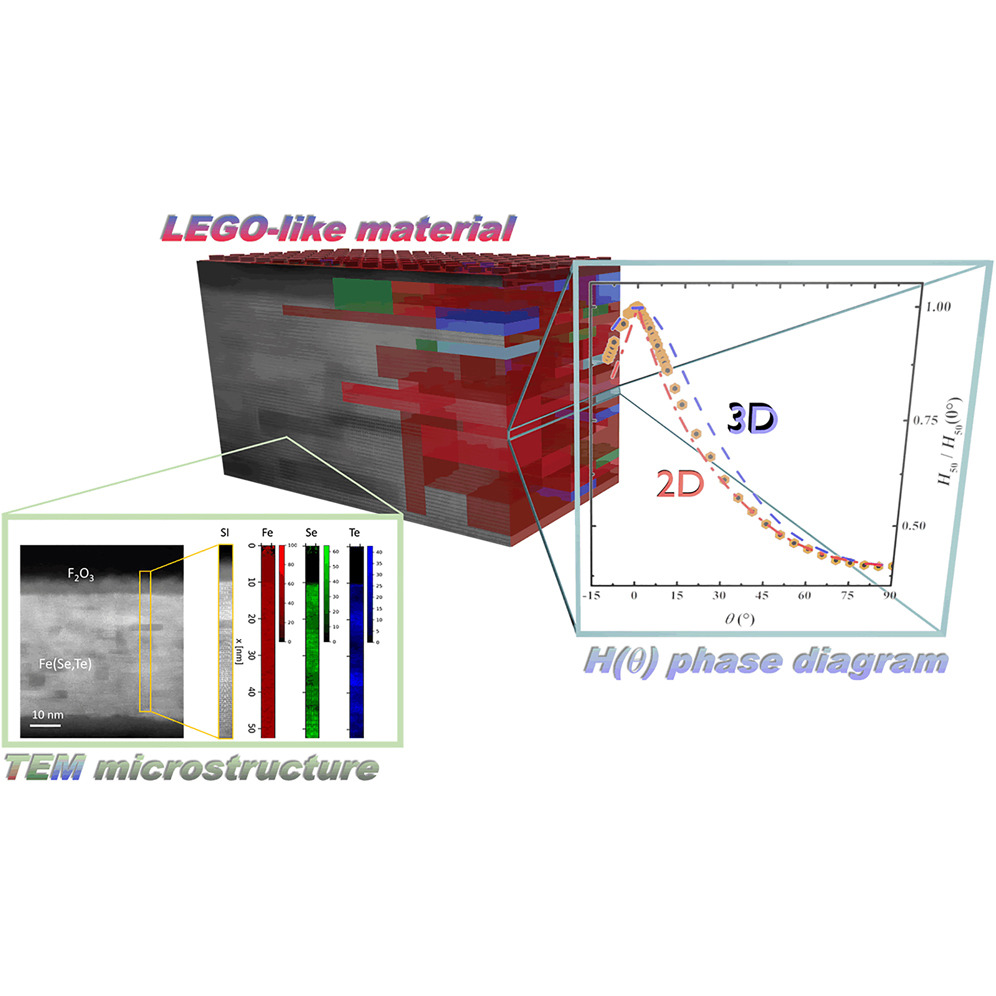
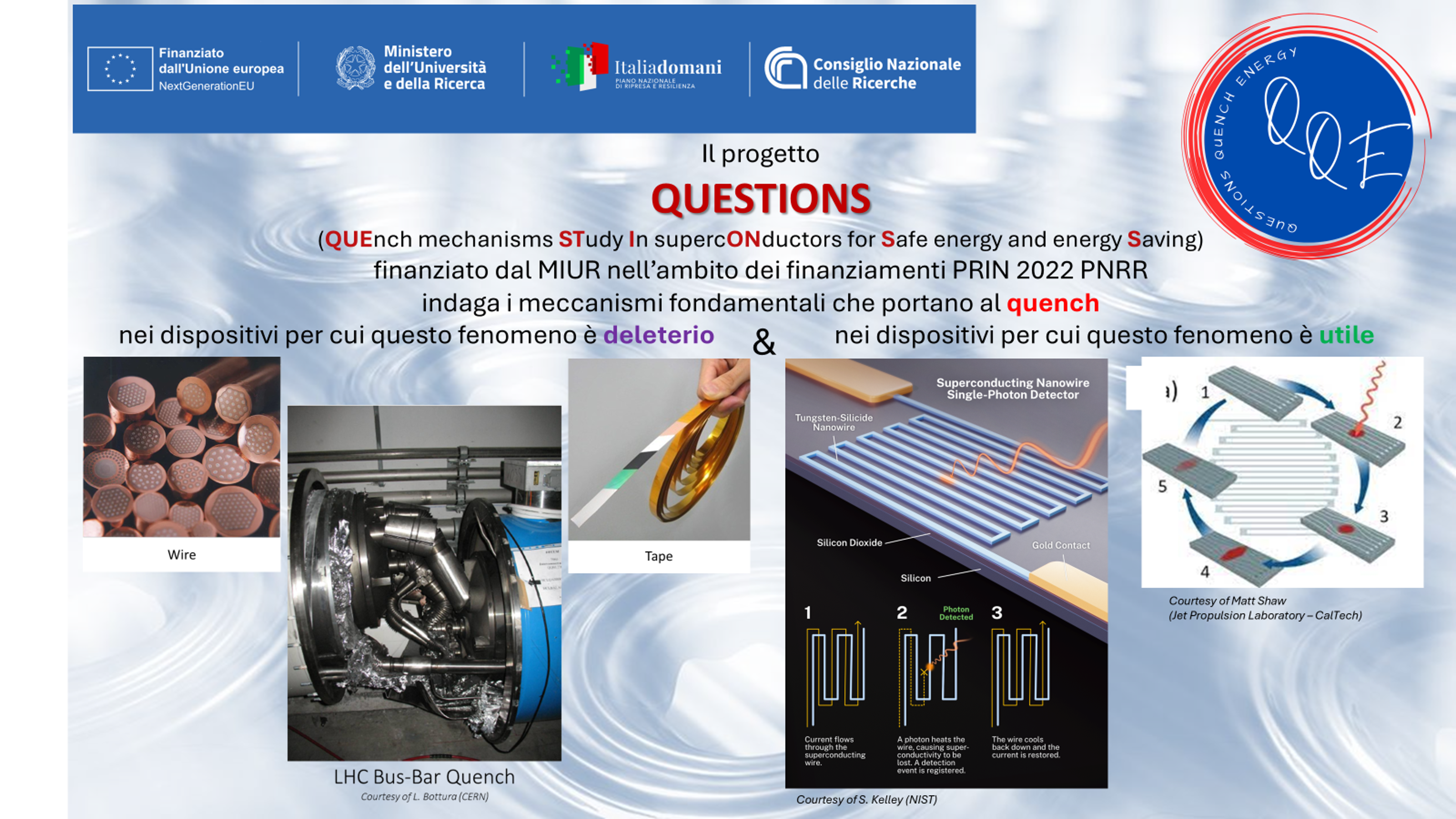
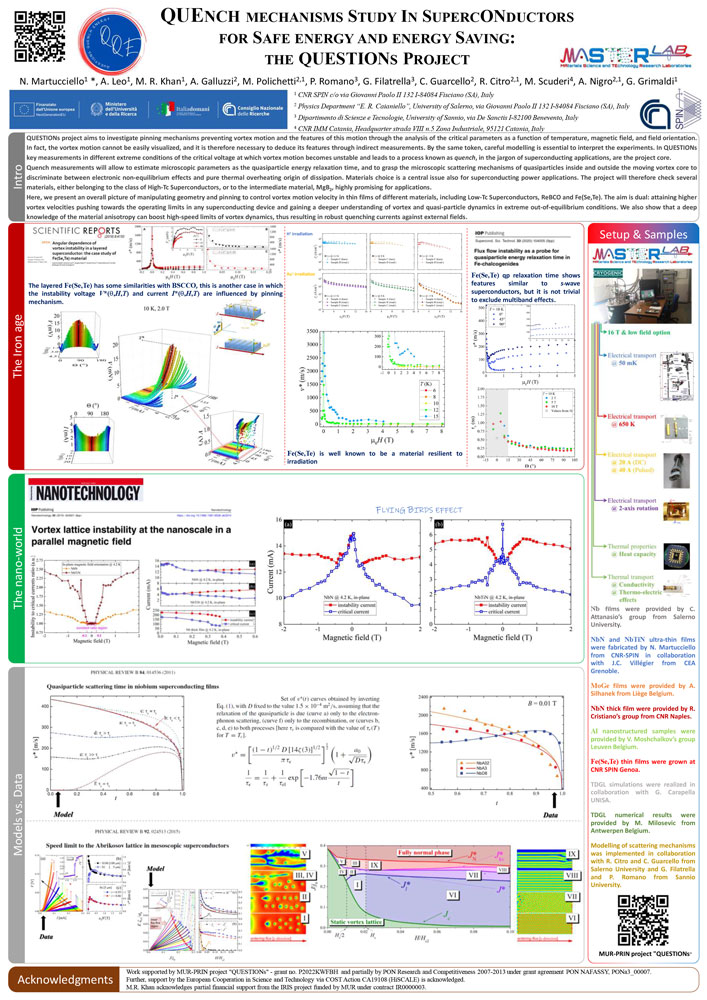
Superconductors are materials in a quantum state characterized by electrons bounded in Cooper’s pairs moving without friction, thus allowing lossless current conduction, that is without any detectable voltage drop. This wonderful property however has some limitations. First, materials need to be cooled at low or very low temperatures. Then, current is limited by a maximum value above which superconductivity is destroyed. Materials with useful critical currents are such because they can keep at bay the penetrating magnetic field that in superconductors occurs as quantized bundles named Abrikosov vortices. Indeed, the Lorentz force due to a bias current acting on vortices can cause their motion entailing a voltage, and ultimately a dissipation. The motion of the flux quanta must be controlled, as dissipation can lead to a catastrophe: the heat increases the fraction of normal electrons in the material, thus causing more dissipation and hence catastrophic negative feedback. The whole process is named quench in the jargon of superconducting power applications. QUESTIONs aims to investigate the pinning mechanisms preventing vortex motion and the features of this motion through the analysis of the critical current and voltage as a function of temperature, magnetic field, and field orientation. In fact, the vortex motion cannot be easily visualized, and it is therefore necessary to deduce its feature through indirect measurements. By the same token, careful modelling is essential to interpret the experiments. In QUESTIONs key measurements in different extreme conditions of the critical voltage at which the vortex motion becomes unstable and leads to quench are the project core. Such measurements will allow to estimate microscopic parameters as the quasiparticle energy relaxation time, and to grasp the microscopic scattering mechanisms of quasiparticles inside and outside the moving vortex core to discriminate between electronic non-equilibrium effects and pure thermal overheating origin of dissipation. A deeper understanding will be also reached with artificial structures that act as pinning centers, to establish their influence on the instability point.
The project has several Tasks within 4 principal Milestones:
M1 - Acquisition and preparation of samples for measurementsSome publications made during the project with specific acknowledgments to the project:

Principal Investigator