UNISA - 2DEGAS
Main menu:
UNISA
UNISA Research Unit – People involved
Prof. Carlo Barone (Responsible)
Prof. Sergio Pagano
Prof. Francesco Romeo
UNISA Research Unit – Activity
The Unit is active in the investigation of transport properties of advanced materials and devices through noise spectroscopy. The spectral analysis of low frequency noise (noise spectroscopy) is a powerful tool to study the properties of these materials, as it highlights the sources of intrinsic fluctuation of the transport properties, allowing to shed light on the basic mechanisms at work and also to set the ultimate limits of achievable performance of devices made from such materials. The investigated systems comprise:
● 2D gas nano-sensors and electron gas interfaces;
● green electronics materials;
● high Tc superconductors;
● manganites;
● solar cells (crystalline, polymeric, perovskites);
● carbon nanotube composites;
● metals.
Other research areas covered by the researchers of the unit are the development of innovative superconductive devices, based on superconducting nanostructures and on Josephson junctions for the realization of single photon detectors in the visible, IR and microwave spectral regions and related superconducting electronics. The applications of such superconducting devices are:
● Fast optical interfaces for superconducting digital circuits;
● Secure optical telecommunications (quantum key distribution);
● Qubit interfacing.
● Quantum sensing
Available equipments:
● Closed cycle low temperature noise test station (10 to 300 K)
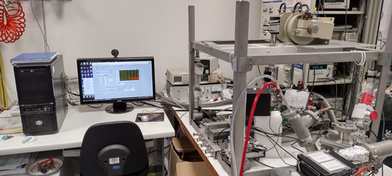
● Closed cycle ultra-low temperature test station (0.3 to 300 K)
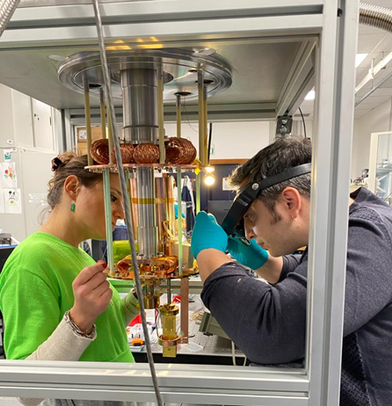
● Continuous flow optical cryostat (3 to 300 K)
● Test camera for room temperature electronics (-40 to 120 °C)
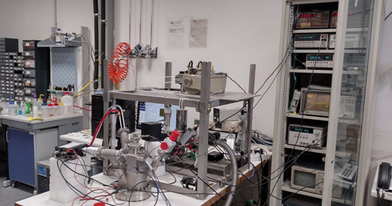
● Wire bonder
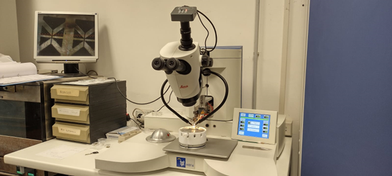
● Microwave generators 0-20 GHz
● Spectrum Analyzers (0-100 kHz, 0-3 GHz and 0-20 GHz)
● Pulsed Laser optical sources from IR to UV
● 100 fs Laser source at 1550 nm
● THz station.