UNIVAQ - 2DEGAS
Main menu:
UNIVAQ
UNIAQ Research Unit – People involved
Prof. Maurizio Passacantando
Prof. Luca Lozzi
UNIAQ Research Unity – Activity
The UNIAQ research unity investigates growth, surfaces/interfaces, and transport in low-dimensional materials and nanodevices, coupling device fabrication with advanced microscopy and photoemission. UNIAQ work spans chemoresistive gas sensing, field emission, and opto/electronic transduction, leveraging XPS/UPS, STM/AFM, SEM, XRD, and electrical I–V/field-emission measurements to correlate structure with function. The investigated systems comprise:
· WS₂ nanotube devices and heterostructures with graphene
· Electrospun metal-oxide nanofibers (WO₃, TiO₂)
· Carbon nanostructures (CNTs, graphene)
· TMD nanostructures (MoS₂ nanoflowers/bilayers)
Other research areas covered by the Unit include surface and interface physics of ultrathin films and metal–organic interfaces for organic/optoelectronic devices, exploiting a comprehensive toolkit (XPS/UPS, LEED, STM/AFM).
Available equipments
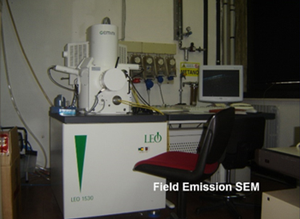
• ZEISS LEO 1530 (FE-SEM) with Kleindiek micromanipulators – Field-emission SEM for high-resolution imaging and in-situ electrical probing.
0.1–30 kV; ~1.0 nm resolution @ 30 kV; InLens/SE detectors; in-situ micro/nano-probing Kleindiek (MM3A-EM).
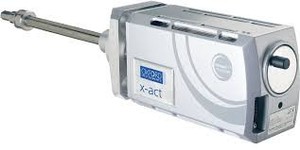
• Oxford Instruments X-ACT 100 (EDS) – Silicon drift detector for SEM-EDS microanalysis. ~125 eV (Mn Kα) energy resolution; Be–Pu detection range; LN₂-free operation; INCA/AZtec software.
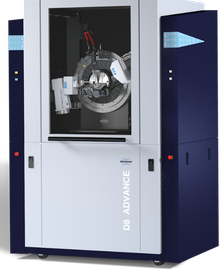
• Bruker D8 ADVANCE (XRD) – θ–2θ powder diffractometer for phase and texture analysis. Cu Kα configuration; step size down to 0.0001°; LYNXEYE 1D detector.
• Perkin-Elmer PHI ESCA (XPS) – Surface chemical analysis with hemispherical analyzer.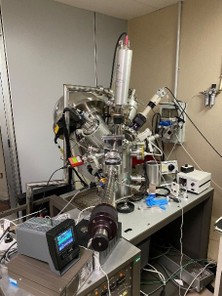
Dual-anode Mg/Al source; 0–4800 eV scan range; ≤0.5–0.6 eV energy resolution; UHV base pressure ~5×10⁻¹⁰ Torr.
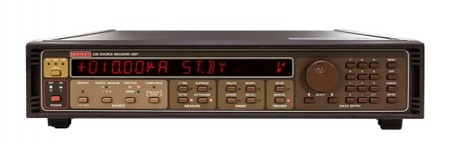
• Keithley 236 (SMU) – Four-quadrant source-measure unit for I-V characterization. ±110 V, ±100 mA; current sensitivity down to ~10 fA; GPIB interface.
• CVD Tube Furnaces (horizontal, compact setup) 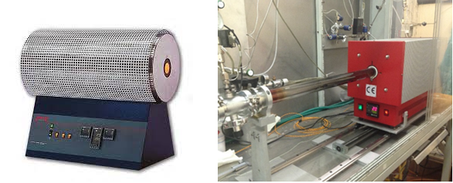
Single-zone furnace on rail for rapid sample loading and process control.
Max temp 1100–1200 °C; hot zone ~150–250 mm; digital PID controller; quartz/alumina tube compatible; integrated vacuum line (rotary pump) with back-pressure control; quick-connect gas inlets.